
Introduction
Steam ejectors are mechanical devices that create a vacuum or compress gases using high-pressure steam as the driving force. They are known for their simplicity, lack of moving parts, and ability to handle large volumes of gases, vapors, or air under varying temperature and pressure conditions. Due to these qualities, steam ejectors are widely used in industries like oil refining, chemical processing, pharmaceuticals, power generation, and desalination.
The primary function of a steam ejector is to produce a vacuum or to transport and compress gases or vapors by converting the energy of pressurized steam into velocity and entraining a secondary gas stream. Their design is based on thermodynamic and fluid dynamic principles, making them efficient in applications where robust, continuous vacuum generation is necessary.
Construction and Main Components
Steam ejectors are relatively simple in construction, consisting of several key components:
- Motive Nozzle: This is where high-pressure steam is introduced. The nozzle converts the pressure of the steam into a high-velocity jet. This jet is essential for creating the vacuum and entraining the secondary fluid.
- Suction Chamber: This section surrounds the motive nozzle and is open to the low-pressure gas or vapor that needs to be removed. The low pressure created by the high-velocity steam jet draws the suction fluid into the mixing chamber.
- Mixing Chamber: Here, the high-speed steam and the entrained suction gases mix together. The momentum of the steam jet transfers energy to the suction fluid, creating a homogenous mixture.
- Diffuser: In the diffuser, the mixed stream slows down, converting some of its velocity back into pressure. This enables the mixture to be discharged at a pressure sufficient to be expelled or passed into the next stage if it is a multi-stage system.
Working Principle of a Steam Ejector
The working principle of a steam ejector is rooted in the laws of thermodynamics and the Venturi effect. When steam is expanded through a specially designed nozzle, its pressure drops significantly, and its velocity increases to supersonic speeds. This jet of high-velocity steam enters a suction chamber, creating a low-pressure zone.
This low-pressure zone enables the ejector to draw in gases or vapors from the system or process that requires evacuation. As the steam jet and the entrained gas enter the mixing chamber, the two streams interact, and momentum is transferred from the steam to the gas. The mixture then passes into the diffuser section where it decelerates, and part of the velocity energy is converted into pressure, allowing the gas-steam mixture to be discharged at a moderate pressure.
Steam ejectors do not require external power sources other than the motive steam, and they operate continuously without moving parts, which adds to their reliability and durability.
Types of Steam Ejectors
Steam ejectors can be classified based on the number of stages and the type of cooling or condensation methods used.
Single-Stage Ejector
This is the simplest form of a steam ejector and is used when only a moderate vacuum is required. Single-stage ejectors are suitable for applications where the vacuum level does not need to be extremely deep. They are compact and easy to maintain but are limited in how low a pressure they can achieve, typically down to around 75 to 100 mmHg absolute.
Multi-Stage Ejector
When a deeper vacuum is needed, multiple ejector stages are used in series. Each stage handles a portion of the compression from a lower to a higher pressure. Between stages, condensers are often placed to condense out steam and reduce the load on the next stage. This configuration allows for vacuum levels down to as low as 0.001 mmHg absolute. Multi-stage systems are commonly found in large chemical plants, vacuum distillation columns, and power generation facilities.
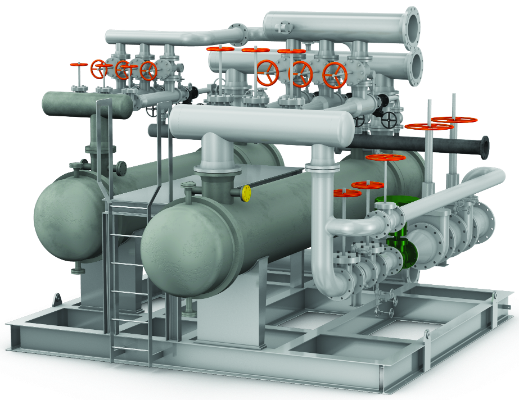
Ejectors with Condensers
These include either inter-condensers or after-condensers to reduce steam consumption. The condenser removes the steam portion of the mixture between stages or after discharge, which reduces the volume of gases entering the next stage. This results in lower steam usage and improved overall efficiency.
Limitations of Steam Ejectors
Despite their many advantages, steam ejectors do have some drawbacks. Their efficiency can be lower compared to mechanical vacuum systems, especially when running at part-load conditions. Steam consumption can be high if not properly designed or if steam quality is poor (wet steam causes nozzle erosion and energy loss).
Additionally, multi-stage ejectors with condensers require a consistent supply of cooling water and good quality condensate handling. The footprint and complexity of multi-stage systems are also greater than those of single-stage systems, and precise sizing and engineering are critical to avoid underperformance.
Design and Selection Considerations
Choosing the right steam ejector system requires a detailed understanding of the application. Key factors include the required vacuum level, available steam pressure and temperature, the nature and volume of the gases to be handled, and whether the gas contains condensable vapors or particulates.
Material compatibility is crucial, especially in chemical or corrosive environments. The presence of non-condensables, cooling water availability, space constraints, and economic considerations also influence ejector design. Proper design ensures optimal steam consumption and performance.
Maintenance Tips
Although steam ejectors are low-maintenance devices, some routine practices can enhance their life and efficiency. Nozzles should be inspected periodically for scaling, erosion, or damage, especially if steam quality is poor. The suction and discharge passages should be free from blockages or buildup. Condensers (if present) should be descaled and cleaned to maintain heat exchange efficiency. Steam traps should be checked to avoid condensate carryover, which can affect performance and damage internal surfaces.
Conclusion
Steam ejectors are an indispensable part of many industrial vacuum systems and their rugged construction, simplicity, and ability to operate under extreme and corrosive conditions make them a trusted choice across a wide range of applications. When properly designed and maintained, steam ejectors offer consistent, long-lasting vacuum performance without the need for complex machinery or extensive maintenance. Whether used in a refinery, power plant, or chemical processing facility, steam ejectors continue to provide a reliable and cost-effective solution for process vacuum needs.