
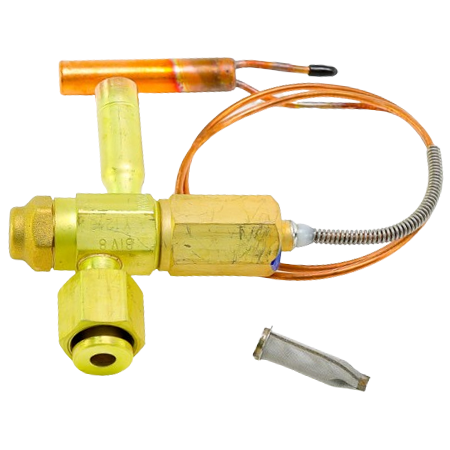
TXV in Oil Chillers (Thermal Expansion Valve) is one of the most critical components in ensuring efficient and reliable operation of the refrigeration circuit. It regulates the precise amount of refrigerant entering the evaporator, depending on the system’s cooling demand. In oil chillers—used to cool industrial oils such as hydraulic oil, spindle oil, compressor oil, and gear oil—the role of the TXV becomes even more essential due to complex fluid properties, high thermal inertia, and sensitive viscosity control.
Unlike water chillers, oil chillers require tighter thermal regulation, as oil’s thermal conductivity and specific heat are significantly lower. Therefore, the performance of the TXV directly affects cooling efficiency, compressor safety, oil stability, and process accuracy in a wide range of industrial applications
Understanding TXV: Working Principle
A TXV (Thermostatic Expansion Valve) is a dynamic throttling device that meters refrigerant flow into the evaporator based on real-time load demand.
It operates on three main forces:
- Bulb Pressure – Created by the temperature of the suction line sensed by a thermal bulb attached to it.
- Spring Pressure – Internally adjustable to set the desired superheat.
- Evaporator Pressure – Opposing pressure from inside the evaporator.
The TXV opens or closes its needle valve accordingly to maintain constant superheat, ensuring the evaporator is fully utilized without flooding the compressor.
Why TXV is Essential in Oil Chillers
Accurate Superheat Control
- Oils take longer to respond to cooling; a TXV ensures precise superheat, balancing refrigerant evaporation with the slow heat transfer from oil.
- Prevents underfeeding (inefficient cooling) and overfeeding (risk of liquid refrigerant reaching compressor).
Stable Oil Temperature = Stable Viscosity
- Industrial oils change viscosity rapidly with temperature.
- TXV prevents temperature overshoots and maintains oil within optimal viscosity range, preserving lubrication and component protection.
Load Adaptability
- Oil chillers often experience variable loads due to fluctuating machine operations (e.g., changing RPMs in spindles or cyclic presses).
- TXVs respond instantly to load changes, ensuring consistent refrigerant flow.
Compressor Protection
- A properly tuned TXV ensures only superheated vapor returns to the compressor—protecting it from liquid slugging and mechanical failure.
Better Energy Efficiency
- By metering just the right amount of refrigerant, TXVs optimize compressor runtime and minimize energy waste—especially during partial load conditions.
Design Considerations in TXV-Equipped Oil Chillers
Refrigerant-Oil Compatibility
- The type of oil and refrigerant pair (e.g., R-134a with synthetic oils) impacts TXV sizing and orifice selection.
Sensing Bulb Placement
- The bulb must be tightly clamped to the suction line and properly insulated for accurate temperature detection.
External vs. Internal Equalization
- Large evaporators or those with pressure drops require externally equalized TXVs to maintain correct valve performance.
Material Selection
- Since oils may contain additives or impurities, TXVs should use corrosion-resistant internals—stainless steel, Teflon seats, or brass bodies.
Multi-Evaporator Systems
- Some oil chillers cool different zones (e.g., lube oil + hydraulic oil) and require independent TXVs for each circuit.
Emerging Innovations
- Smart TXVs: Equipped with sensors and stepper motor actuators for near-EEV accuracy, useful in digitally controlled chillers.
- TXV with electronic assist: Hybrid valves that combine thermal control with electronic fine-tuning.
- Low-GWP Refrigerant Compatibility: New TXV designs are being made to work with R-1234yf, R-290, and CO₂ systems to support eco-friendly chillers.
Challenges of Using TXV in Oil Chillers
- Slower response due to oil’s thermal inertia: Oil takes longer to transfer heat to the evaporator, which may lead to TXV tuning delays if not properly calibrated.
- Oil contamination: Impurities can clog small TXV passages, requiring filtration systems.
- Oil return issues: Low temperature or excessive refrigerant may cause poor oil return to compressors; TXV needs to be part of a carefully engineered loop.
TXV in Oil Chillers acts as the intelligent gatekeeper that balances refrigerant flow with the cooling demands of high-value industrial oils. Whether it’s keeping hydraulic fluid at optimal viscosity, preventing spindle overheating, or preserving the life of expensive lubricants, the TXV ensures thermal precision, compressor safety, and energy efficiency.
With increasing demand for precision manufacturing, longer equipment life, and sustainable energy usage, TXVs remain indispensable in oil chiller technology, adapting easily to varying loads, operating environments, and refrigerant types. A well-selected and calibrated TXV is not just a component—it’s the heart of refrigerant flow control in any oil chiller system.