
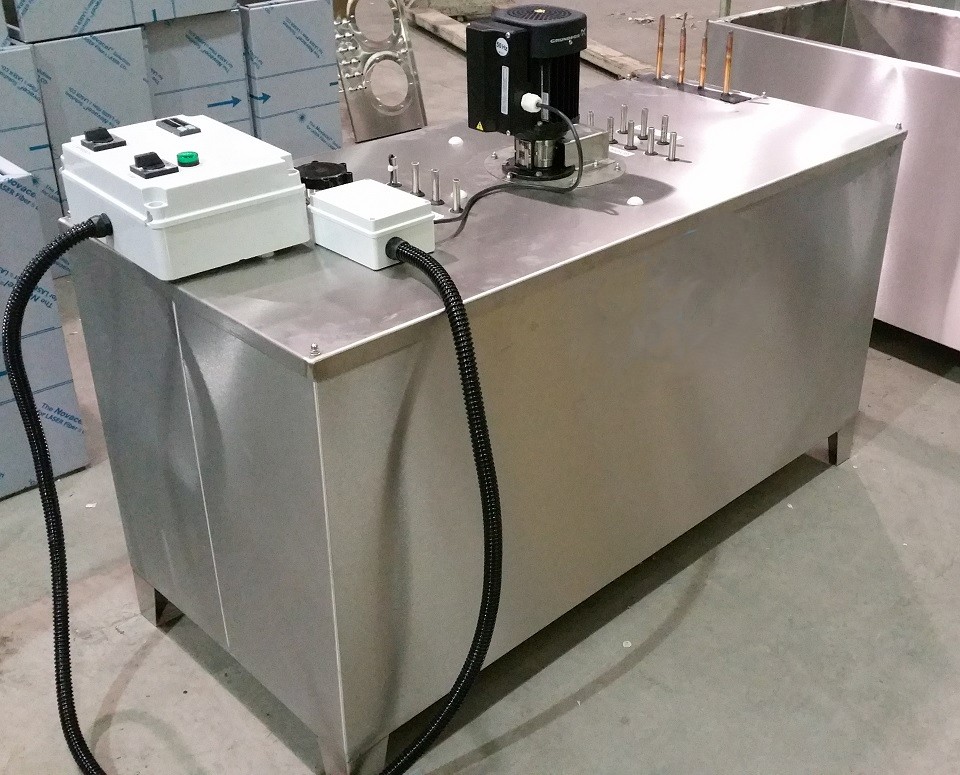
Multi-Zone Glycol Chiller is a highly engineered industrial refrigeration unit designed to cool multiple independent loops or zones, each with unique temperature setpoints and flow requirements, using a glycol-water mixture as the heat transfer fluid. These systems are used in manufacturing and process applications where different stages or equipment require precise and simultaneous cooling, often under varying thermal loads.
Unlike conventional chillers that offer a single cooling output, a multi-zone glycol chiller provides a modular temperature control system, all within one integrated chassis. It offers tailored cooling without requiring multiple standalone chillers, thus reducing capital cost, space, energy consumption, and complexity.
Why Use Glycol? – A Critical Component for Industrial Cooling
Thermodynamic Reliability
Glycol acts as a thermal transfer fluid that allows systems to maintain stable and consistent temperatures, especially important in applications that require sub-ambient or even sub-zero cooling.
Freeze Protection
One of the primary reasons glycol is used is its ability to lower the freezing point of water, protecting pipes, coils, valves, and other components from freezing even when external temperatures drop below 0°C.
Corrosion Inhibition
Formulated glycols often contain corrosion inhibitors, which protect internal metallic surfaces like copper, brass, stainless steel, and aluminum from rust, scale, and pitting.
Bio-Fouling Resistance
Glycol prevents microbial growth in stagnant or low-flow systems, keeping loops clean and maintenance-friendly—especially important in food, beverage, and pharmaceutical applications.
Thermal Stability
Even in systems with high flow turbulence or cyclic temperature variation, glycol maintains its heat transfer capability and doesn’t degrade easily under normal operating conditions.
How a Multi-Zone Glycol Chiller Works – System Architecture
A Multi-Zone Glycol Chiller consists of several core components, each contributing to its ability to manage temperature accurately across different zones:
Central Refrigeration Circuit
- One or more compressors (reciprocating, scroll, or screw)
- Condenser (air or water-cooled)
- Expansion valves and evaporator
This central loop is responsible for bringing the glycol-water mixture down to the lowest desired setpoint for any of the zones.
Insulated Glycol Reservoir
- Stores the chilled glycol solution
- Acts as a thermal buffer to absorb sudden load changes and prevent compressor short cycling
Dedicated Zone Pumps
- Each zone is equipped with its own variable-speed or fixed-speed pump to deliver glycol at the required pressure and flow
- Prevents temperature overlap and flow starvation between zones
Key Technical Features
True Thermal Zoning
Each loop runs independently, meaning a malfunction in one loop doesn’t affect the others. Ideal for critical processing where failure in one zone can result in spoilage or process loss.
Shared Cooling Engine, Distributed Delivery
Centralized chilling is much more efficient in terms of compressor loading, refrigerant charge, and maintenance. However, distributed pumps and thermostats allow custom zone cooling, keeping the system lean yet powerful.
Load Balancing and Flow Regulation
Advanced systems use pressure-balancing valves, flow meters, and VFDs to dynamically adapt pump speed and refrigerant flow based on load per zone.
Built-In Redundancy
Many multi-zone systems feature:
- Dual-compressor redundancy
- Auto-bypass loops
- Backup pumps
…making them extremely reliable even during partial failures or maintenance.
Multi-Zone Glycol Chiller is more than just a cooling unit — it’s a sophisticated process management tool that empowers industries to take complete control over their thermal environment. From breweries to biopharma, and from plastics to petrochemicals, this system ensures that every zone is cooled with surgical accuracy, without compromising efficiency or uptime.
It offers unparalleled flexibility, scalability, and operational intelligence, all in a compact and centralized format. By integrating glycol for thermal fluid safety and multi-zone logic for thermal independence, it becomes the ideal solution for 21st-century manufacturing and production environments.
Whether you’re building a high-mix batch plant or scaling up an advanced process facility, investing in a Multi-Zone Glycol Chiller means securing energy-efficient, reliable, and smart cooling for years to come.